I made a thing. It’s called FlowFrame. It’s a practice suite.
Prelude: The Line Between Boredom and Overwhelm
“The best moments usually occur when a person’s body or mind is stretched to its limits in a voluntary effort to accomplish something difficult and worthwhile.” — Mihaly Csikszentmihalyi
Psychologists map flow on a simple graph: challenge on one axis, skill on the other. When the two rise together you enter the flow channel. Below it lurks boredom, above it anxiety.
Instrumental practice lives on that razor’s edge. Push too hard and the metronome becomes an accusing tyrant; coast too long and you start scrolling instead of shedding. Staying inside the channel demands a frame that grows with you.
Frames, Not Cages
I made FlowFrame to be a tool that enables musical expression, not one that dictates it. In my own practice, I wanted something flexible enough to support exploration—but firm enough to provide structure. Not a cage, but a frame.
A good practice framework does three things:
• Clarifies the immediate goal. (“Lock in my rhythm and pitch.”) • Provides real-time feedback. (Was that tuplet really even?) • Scales the next challenge upward the moment mastery appears.
FlowFrame does all of this in a way that puts the user in control. You’re not just following a pre-built track, you’re designing your own terrain. Whether you’re creating click patterns from scratch, linking pitch drones to rhythmic cycles, or building a progressive routine for a student, FlowFrame adapts to your artistic goals.
How It Compares
Tool Type
What It Offers
What It Misses
FlowFrame’s Difference
Metronomes (Soundbrenner, Pro Metronome)
A basic pulse, subdivision
No harmony, no piece-length programming, no context
Full-score metronome with programmable clicks, tuplets, modulations, and drones
Tuners (Tonal Energy, Tunable)
Pitch accuracy, visual feedback
No rhythmic context, no timing support
Real-time harmonic support aligned to rhythm, not isolated tones
DAWs (Ableton, Logic, Reaper)
Total flexibility
High setup time, steep learning curve, overkill for basic tasks
Zero setup browser-based environment for rhythm + pitch + structure
Music-Minus-One apps (Metronaut, Tomplay)
Pre-recorded tracks, built-in repertoire
Fixed repertoire, no customization
Fully customizable patterns + public pattern library = personalized, shareable practice content
Where these tools specialize narrowly (timing, pitch, playback) FlowFrame unifies those elements around your musical goals. The frame holds when you need it, and it disappears when you don’t.
Beyond the Widget
• FlowFrame isn’t another “metronome-plus.” It’s a practice ecosystem: • Timing drones & harmonies anchored to any click pattern for rock-solid pitch. • Educator linking that turns assignments and feedback into an asynchronous dialogue. • Growing pattern library that crowdsources solutions to tomorrow’s rhythmic puzzles. • FreeFlow timers for pieces ruled by seconds instead of bars.
In other words, it’s the scaffolding that lets musicians climb higher without losing their footing.
Epilogue: A Wider Horizon
Flow thrives on balance: challenge and ability, structure and spontaneity. FlowFrame’s job is to hold that balance just long enough for you to tip it again, to move the horizon a measure farther. It is, quite literally, a frame for flow and the better the frame, the more daring the art that can live inside it.
You know that feeling when you’ve spent weeks with a piece of music, and suddenly you start hearing all these little details you missed before? The way a particular harmony shifts, or how two instruments blend in just the right way? As musicians, we get this experience all the time. But what about our audiences? Why is there a perception that audiences consider contemporary classical music to be inaccessible?
This question hit home recently during a concert I organized with the Lawrence University New Music Ensemble (LuNuMu). We were premiering nine new works written for an admittedly unusual combination – flute ensemble and trombone ensemble (more on that later). But instead of just throwing these brand new pieces at our audience, we tried something different, inspired by psychologist Ellen Langer‘s research on the power of “noticing.”
The Problem with New Music (It’s Not What You Think)
Here’s the thing about contemporary classical music: it often gets a bad rap for being “difficult” or “inaccessible.” I know I’m not alone in believing that’s not really the problem at all. Maybe the real issue is that we’re asking audiences to instantly appreciate complex musical works that we, as performers, have spent weeks or months getting to know.
Think about your favorite album. Chances are, you didn’t fall in love with it on the first listen. You noticed new things each time you played it – that subtle bass line, the background vocals, the way the drums drop out in the bridge. But in classical music, especially with premieres, we typically give audiences exactly one shot to “get it.”
Enter: The Noticing Experiment
So we tried something different. Armed with Langer’s research showing that the simple act of noticing increases positive experiences, we turned our audience into active participants. Through a QR code projected during the performance, we invited them to share what they noticed in each piece.
The responses were fascinating. Some people zeroed in on technical elements like microtonality and percussive effects. Others went pure emotion: “thrilling,” they wrote, or “horror-movie-like.” Some noticed the “fluttering” quality of certain passages, while others found moments of mystery.
What’s particularly interesting is how these observations started to create a kind of collective listening experience. While our performers had weeks to discover these pieces’ complexities and subtleties, our audience was discovering them in real time, sharing their observations like a group of musical explorers mapping new territory.
Beyond Just Listening
Here’s what makes this approach so powerful: it transforms the audience from passive listeners into active participants. Instead of just sitting there trying to absorb everything at once, they’re engaged in a process of discovery. It’s like giving them a lens through which to focus their attention, making the unfamiliar more approachable.
And yes, all of this happened during a concert featuring the somewhat unlikely combination of flute and trombone ensembles (a story involving professional collaboration and marriage – but that’s for another blog post). The point is that when we give audiences tools to engage with new music, magical things can happen.
The Bigger Picture
This experiment suggests something important about how we present contemporary music. Maybe instead of worrying about making new music more “accessible,” we should focus on helping audiences develop their own relationship with it. By encouraging active listening and noticing, we’re not just presenting music – we’re creating an environment for discovery.
Think about it: when was the last time you really noticed what you were hearing? Not just listened, but actively noticed? Try it sometime. You might be surprised at what you discover.
Fireflies – Chelsea Majkut
All That is Solid – Sofia Jen Ouyang
All Your Breakers and Your Waves – David Acevedo
Departure – Ty Bloomfield
Reaffirmations – Helder de Alves Oliveira
Stained Glass Angels in Refraction – Michael Kahle
Melodrama for soprano and chamber orchestra (2008)
No. 42(In The Alps) by Richard Ayres is an orchestral trombonist’s dream: part Strauss, part Rossini, part Mahler, mostly hilarious. Here’s how the composer Richard Ayres describes it:
No.42 (In the Alps) could perhaps best be described as a melodrama. It combines many of the subjects that fascinate me: the relationship of text narrative and musical narrative, the history of opera, early cinema, the theatrical practices of the nineteenth century, along with the folk and popular music of the Alpine region.
A girl (the soprano), stranded on top of an un-climbable mountain peak as a young baby, is taught to sing by the mountain animals. Young Bobli lives in the village far below the un-climbable peak. He was born mute and communicates with the world by playing the trumpet. Bobli hears the soprano’s song drifting down into the valley. The soprano listens to Bobli’s trumpet tunes blown up to her by the wind. They are both enchanted.
The three acts are separated by interludes describing how three animals experience time passing in relation to a musical tempo.
Like any self respecting melodrama the text and music combine to depict or imply a wide ranging theatrical adventure, in this piece starting at the Creation (or the big bang), a lonely existence, scenes of rustic village life, some carpentry, many mountain goats, unrequited love, and ending in a quest destined to fail. In a live performance the text [provided with the performance material] is to be projected on a screen behind the musicians in the style of silent movie intertitles.
In the Alps calls for a brass section with two trumpets, two French horns, bass trombone, and tuba. The bass trombone (and this is definitely a bass trombone part) performs both as an ensemble voice as well as a soloist. The piece was written for the Netherlands Blazers Ensemble with Barbara Hannigan (recording available here), and the bass trombone part created with Brandt Attema‘s playing in mind.
Act I, Prelude – Straussian
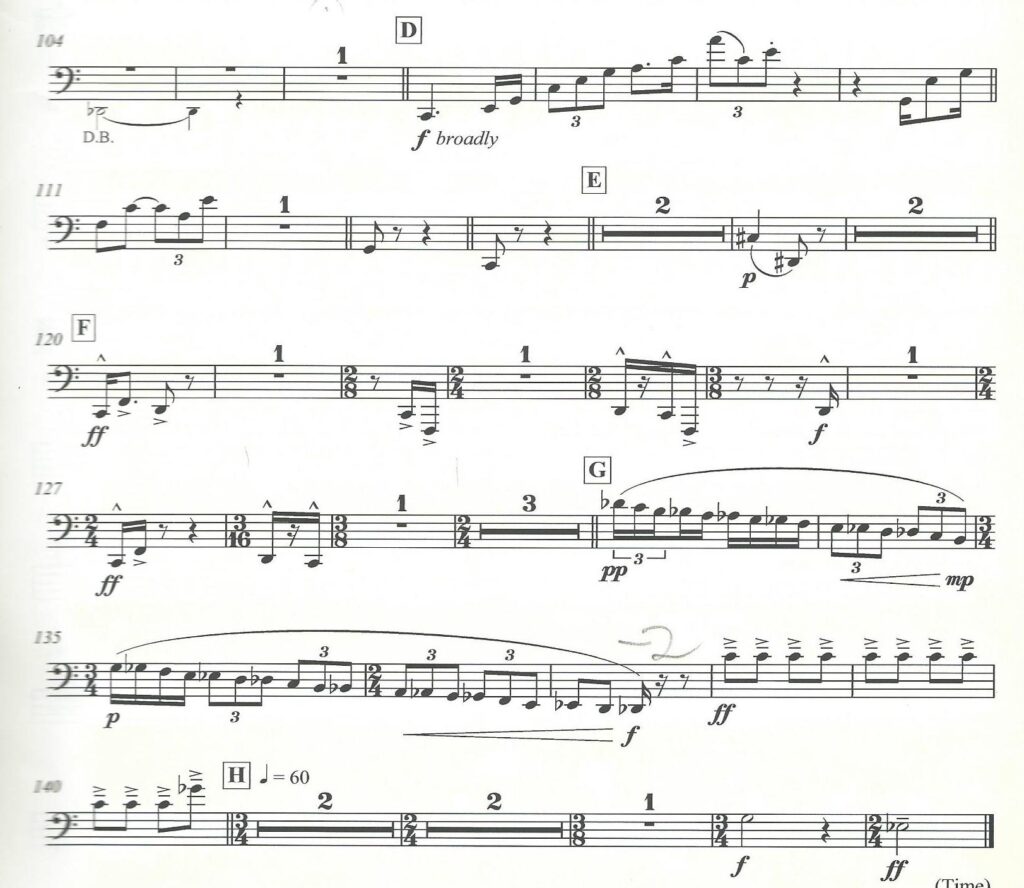
The trombone first enters as an ensemble member at Rehearsal D (Act I, Prelude). This loud moment comes as a surprise after an opening reminiscent of the beginning of Mahler’s First Symphony (ppp). The trombone is doubled with the tuba and both are marked only f, whereas the low woodwinds and double bass, playing different material, are marked fff. This is likely a case of the composer being aware that a trombone f is different than a bassoon f and attempting to balance the instruments.
The fun begins.
Between rhl D and E the brass section plays a Straussian klangfarbenmelodie. At rhl E the ensemble is quiet again and tension builds leading to rhl F. Rhl F contains none of the lyricism of D. The ensemble is in almost complete rhythmic unison on these ff notes. The motives shift abruptly and at unexpected times due to the meter changes.
Rhl G is a sweep of contrary motion that gathers momentum and leads us to full-ensemble rhythmic unison beginning three measures before rhl H.
Act I, Scene 1 – Snoring Bears
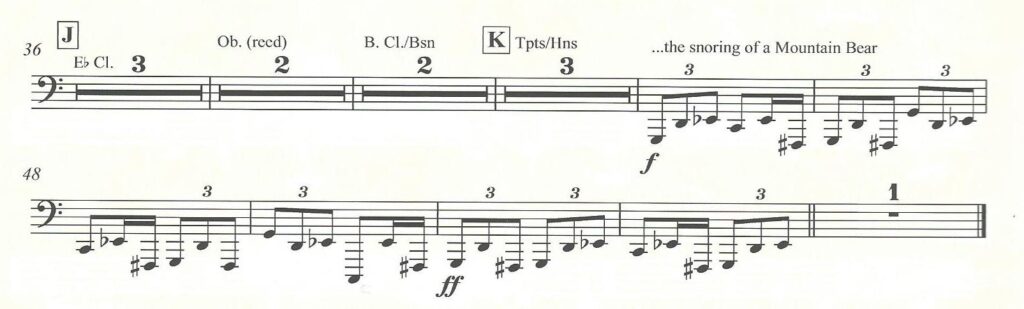
The next trombone entrance is with tuba, contrabassoon, and double bass at the end of Act I, Scene 1. The scene introduces the animals of the Alps one-by-one starting with the song of the nightingale, then the “song” of the cicada, then the hooting of the owl, then the toad, and on and on until the snoring of the mountain bear. By the time the low quartet enters the orchestration is quite thick and it might take a bit of effort to from the full ensemble and quartet to create a balance where the snoring can be heard.
Snoring bears cover quite a range.
(Note: I’m skipping some fun passages but I feel the need to be a bit choosy about things to include.)
Excerpt from Richard Ayres, No. 42 (In The Alps) (Act II, Scene 4) performed by Alarm Will Sound
Act II, Scene 4 – “Bobli Dance”
The town band.
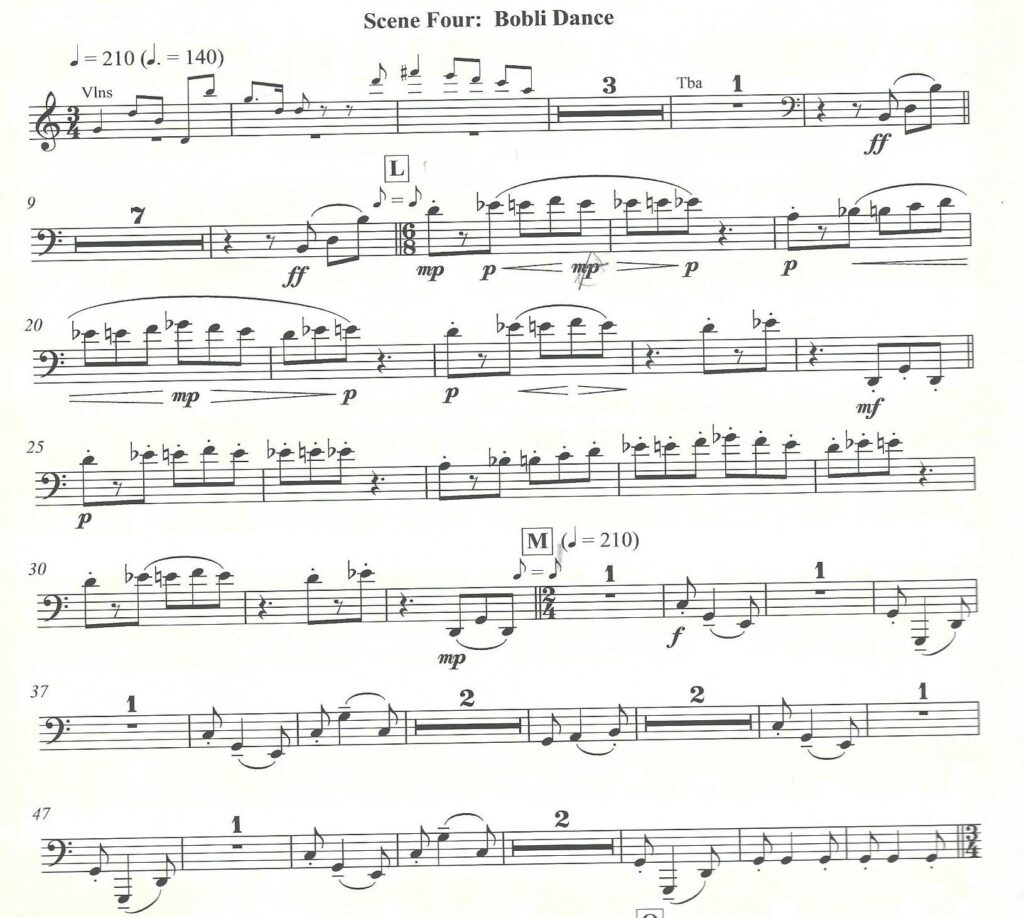
“Bobli’s Dance” (Act II, Scene 4) is a riotous, warped polka that switches between simple and compound subdivisions. While the trombone has the melody at rhl L, it’s secondary to the trumpet (Bobli) who plays “rough, indistinct pedal tones” only occasionally. Bobli is learning to play the trumpet and the rest of the ensemble is the town band backing him up. Playing the passage accurately at tempo requires a nimble slide and special attention to articulations that switch from legato to staccato. The hairpin dynamics can be slightly tricky as well: first the subito mp at L, then the hairpin cresc/dim in the subsequent measures.
Act II, Scene 5 – Low Notes!
I had to count ledger lines and pitches to figure out what note this lick begins on.Excerpt from Richard Ayres, No. 42 (In The Alps) (Act II, Scene 5) performed by Alarm Will Sound
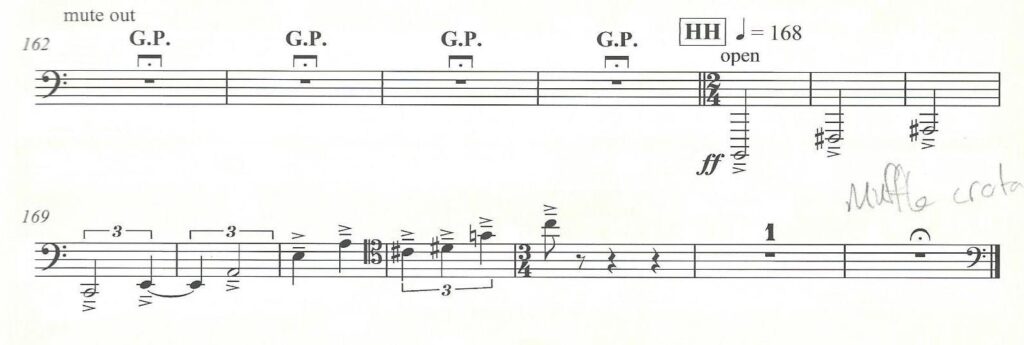
I have to point out Act II, Scene 5, rhl HH as it is the only ff pedal B I know of in the repertoire. The bass trombone is once again with our buddies contrabassoon, tuba, and double bass. The line moves, in unison, seven octaves up the ensemble ending on a ridiculously high E played as a string harmonic.
Act III, Scene 1: The Solo
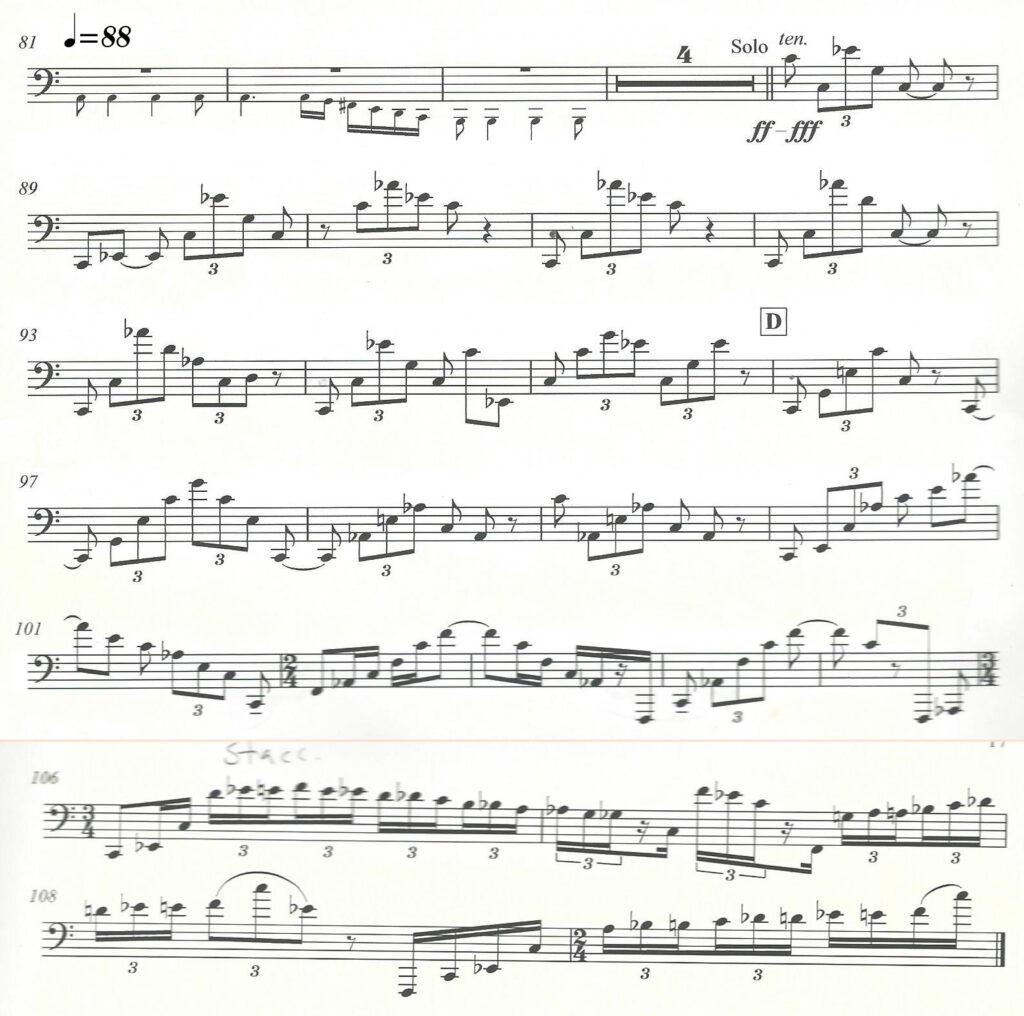
The actual “excerpt” from In the Alps happens in Act III, Scene 1, close to the end of the piece within a storm sequence.
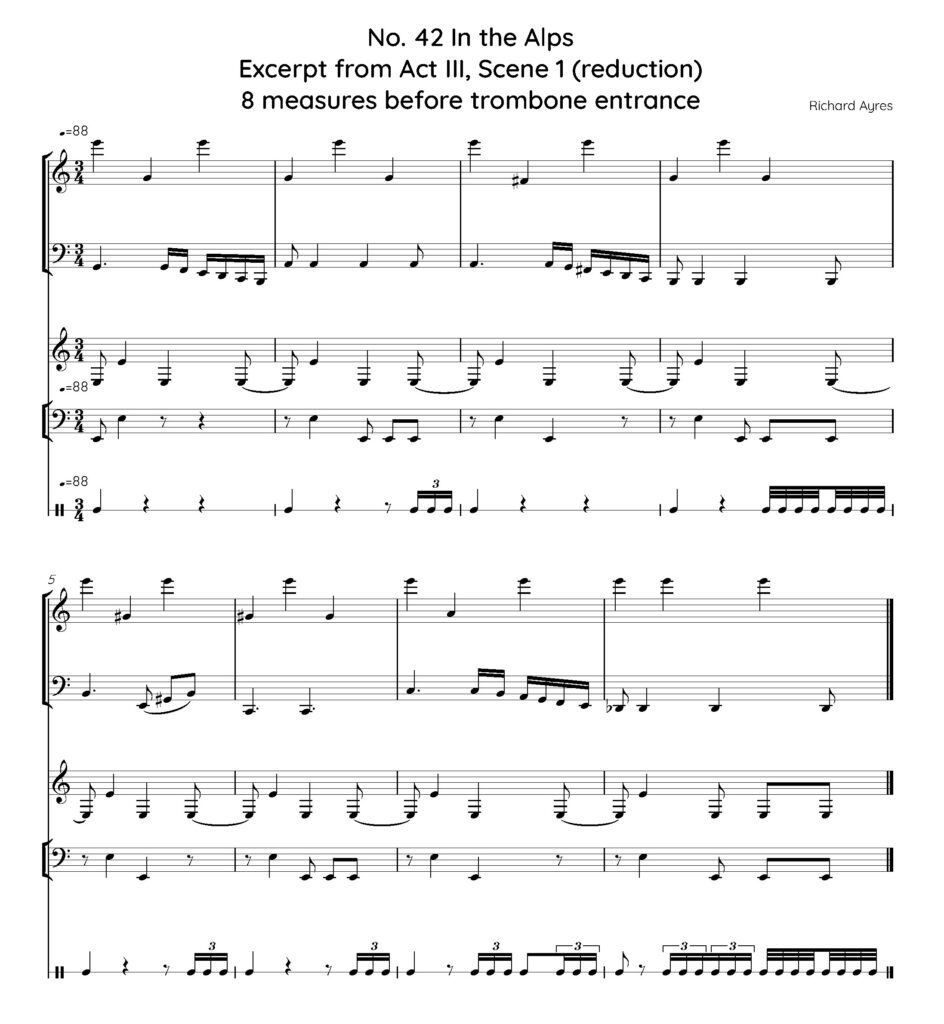
Excerpt from Richard Ayres, No. 42 (In The Alps) (Act III, Scene 1), beginning c. 8 measures before the trombone solo, performed by Alarm Will SoundThe storm solo.
The god Zeus is sitting atop a mountain, feeling ungod-like. He attempts some grandiosity (portrayed by a tuba solo) but when he fails he lets out a sigh that turns into a great storm. At the peak of the storm the trombone enters.
“Peak of the storm” means that once again projection can be problematic. Lone trombone against the full ensemble. What’s more, the rest of the ensemble gets to coast on less technically demanding music. Like the mountain bear earlier, it can be a challenge to project over the ensemble.
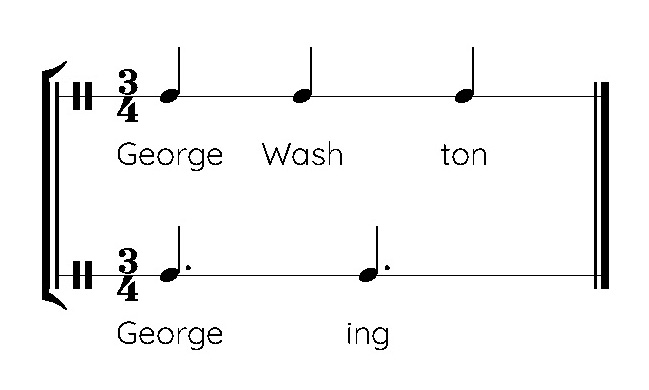
While there are significant technical demands in terms of dynamic (full, projected, evocative of a raging storm brought on by a god), range (three and a half octaves in the final phrase), and articulation (triple tonguing makes the ending easier), the rhythm provides its own challenge. The majority of measures contain triplets over beats. These can be challenging to execute. I found the two most effective methods to practice and perform the excerpt were: 1. To think in eighth note subdivisions, essentially reconceptualizing the passage as quarter notes and quarter note triplets in 6/4, and 2. To internalize the feeling of where the duple falls within each hemiola, making sure that the beat lands after the second eighth note in the triplet (the “ing” of “George Wash-ing-ton”)
2/3 hemiola
Bonus tip 3 that helps 100% of the time: slow it down.
It’s also good to have an understanding of the music that occurs before the trombone entrance. In the chaos of the storm it can be easy to lose track of where you are in the measure. The horns obscure beat 1 by tying across the bar lines and the upper woodwinds and strings play quarter notes in groups of two that can create a feeling of being in 4. It’s best to cue into your buddies in the low woodwinds.
Personal story about performing this piece: This was the first piece I ever performed in concert on bass trombone. I got my instrument in July of 2013 and Alarm Will Sound performed this piece at Carnegie Hall in April of 2014. When I first saw the part I had thoughts about subbing out the gig. Instead I decided to go all in. I scheduled time every day to practice, starting in sections, under tempo, and gradually doing longer and longer chunks at faster speeds. By the time of the concert (which also included music of Donnacha Dennehy, and new works by Kate Moore and Kaki King), I was feeling alright.
Richard Ayres was there for the rehearsals and performance and had nothing to say about the solo. After the concert we all gathered at a bar in Manhattan. I joined Richard at the bar and said, “you wrote one beast of a bass trombone part.” To which he replied something to the effect of, “Oh yeah, you know you didn’t have to play all of that! When I received the commission they told me they had a monster bass trombonist in the ensemble and I should write something really hard for him. I never expected anyone else would play the part!”