Categories
Uncategorized

Land of Winter: Resisting Easy Assumptions

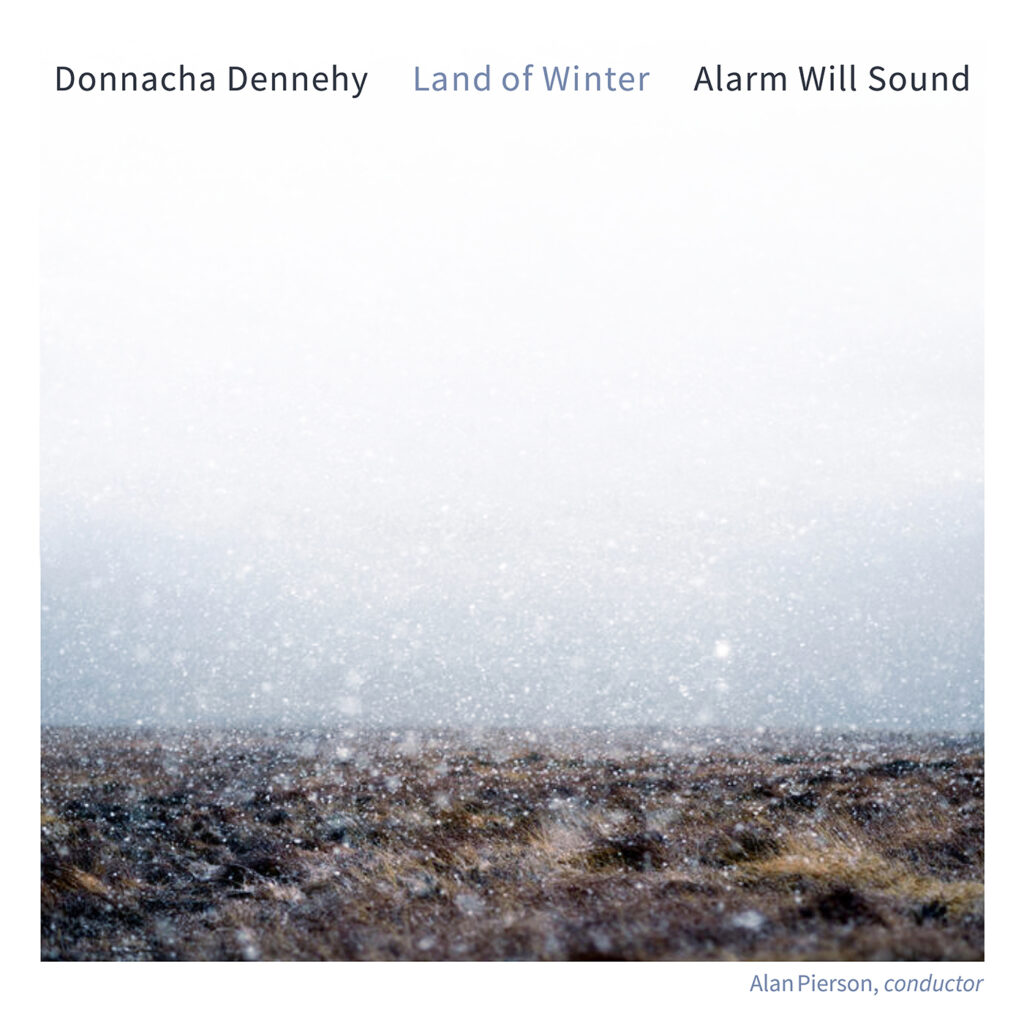
I had a small epiphany today about Land of Winter (Donnacha Dennehy’s large-scale work for chamber orchestra, written for and recorded by Alarm Will Sound.).

Or maybe, given my day job, an alarm sounded.

The piece, in many ways, deals with misunderstandings.

Donnacha often talks about how the Romans called Ireland Hibernia: the “Land of Winter.” From a distance, it must have seemed perpetually cold, grey, and forbidding. But anyone who has actually spent time there knows that’s not quite true. It’s temperate. Changeable.  More about light than cold, and about how radically that light transforms across the year. From what I understand (I haven’t spent much time in Ireland!), at the height of winter and summer, those shifts can feel genuinely extreme.

But the name stuck, even if the reality didn’t quite fit.

Something similar happens every time I describe Land of Winter to people.

When I say it’s by an Irish composer, there’s often an almost imperceptible mental pivot: fiddles, reels, Riverdance, traditional Irish music. None of that is wrong, exactly, but none of it really applies here either. Dennehy’s music lives in a very different sound world, one shaped by spectral harmony, electronics, and contemporary classical techniques, even as a deep sense of place quietly informs the piece in ways that resist anything overtly “traditional.”

And yet, those assumptions are understandable. We all reach for familiar reference points. We label things quickly so we know how to listen, what to expect, how to place them in a mental box.

Land of Winter quietly resists that. It asks for a slower kind of listening. It’s less about postcard images of Ireland and more about time passing, light changing, seasons overlapping. It’s not winter as a stereotype, but winter as a lens. Something you look through rather than something you endure.

Maybe that’s what keeps pulling me back to the piece. It lives in the gap between expectation and experience. Between the name and the reality. Between what we think we’re hearing and what’s actually there if we stay with it long enough.

And maybe that’s true of more things than just this piece of music.

Categories
Uncategorized

Built for Progress: Practice Tracking in FlowFrame

When I started sketching out FlowFrame, it wasn’t just about building a better metronome; it was about creating a space where practice tracking could feel focused, intentional, and rewarding. A place where structure meets flexibility, and where your growth is something you can actually see.

One of the ways FlowFrame supports that is through its practice tracking system. I use it every day, and I figured it might be helpful to show you what that looks like.

Practice Tracking with FlowFrame

Start with a Plan

When I sit down to practice, I open FlowFrame on my phone (though it works just as well on desktop or tablet). I head to the Practice Planner and sketch out a rough outline for the session (or use one I’ve created in advance). Blocks for buzzing, technique work, repertoire—whatever I’m focusing on that day.

Each block gets a label, a projected time, maybe a tempo goal, and a few tags. The tags aren’t just for show; they feed into the analytics later, helping me see how my time gets distributed across different focus areas. (Spoiler: I spend more time on ensemble work than I thought.)

You can also link click tracks to each block. So if I’m running a tricky excerpt from Alarm Will Sound repertoire, I can pull up a custom FlowFrame click with shifting meters and accelerandos baked right in. No fiddling with external apps or cobbled-together solutions. It’s all there.

Practice, Review, Repeat

Once I’m ready, I tap “Start,” and the session begins. If I want, I can record myself. FlowFrame captures the audio and displays a waveform, which I can slow down, annotate with comments or markers, and revisit later.

At the end of the session, FlowFrame prompts a few reflection questions. I’ve customized mine to ask things like, “What surprised me today?” or “What’s something I want to revisit tomorrow?” I don’t always write a novel, but jotting a quick note helps me stay engaged.

Why It Matters

All that data (tags, tempo progress, time spent, reflections) gets saved and visualized in the Review section. It’s not about gamifying practice (though I won’t lie, the confetti is satisfying). It’s about helping you stay connected to the why behind the work.

It’s easy to get lost in the daily grind of practice. FlowFrame helps zoom out, spot patterns, and adjust. Am I neglecting scales? Have I made real progress on that etude? Did I actually do what I said I’d do?

Now I can answer those questions.

Built with You

As always, FlowFrame’s still growing. Many of the improvements come from conversations with musicians who’ve shared what they need and what’s missing in their practice lives. If you’ve got thoughts, I’m listening.

Let me know what you think, or better yet, log in, build a plan, and start tracking.

Your future self will thank you.

Categories
Uncategorized

What I Learned at Dance Class

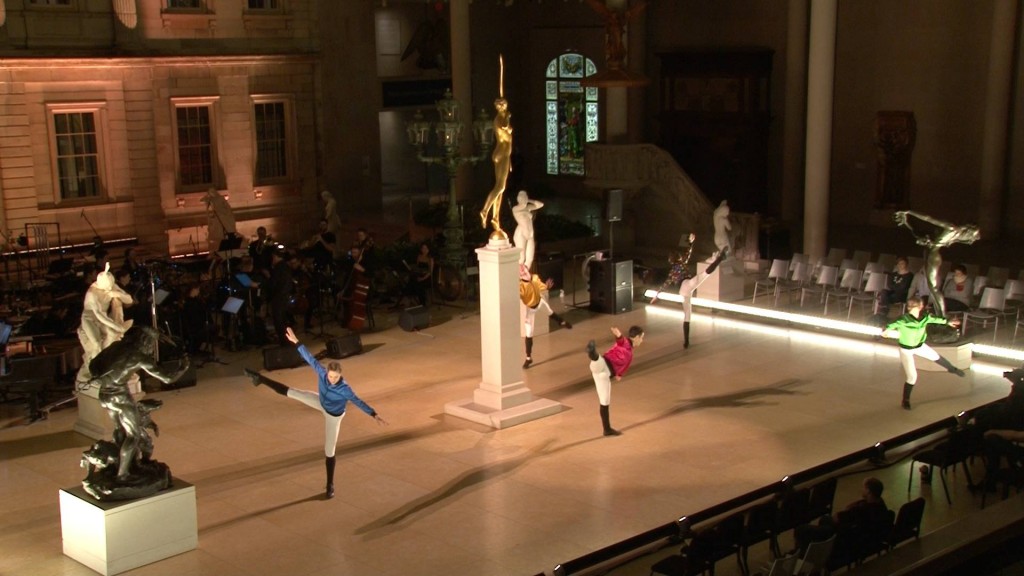
Dance Heginbotham and Alarm Will Sound

Last week I had the great fortune of spending much more time than normal with dancers. First with Dance Heginbotham and Alarm Will Sound at the Metropolitan Museum of Art, then with Cori Kresge and her dance class at Dickinson College. Cori invited me to improvise with her students’ motions. She teaches in the Merce Cunningham style using the technique he codified. It was exciting (I’ve never improvised in a situation like that before) and informative (it seemed like an excellent opportunity to learn something new). Here’s what I took away:

Begin simply

  • They began by jogging around the room and feeling the connection with the floor. That’s got to be a fundamental for dance… dealing with the floor.
  • It’s the same way I begin my musical day. Getting in touch with the most fundamental thing: the sound.
  • Seemed like a good way to begin to get the heart rate up as well.

Look the f%$k behind you

  • At some point during their jog Cori told them to run backwards and watch where they were going (ie. To look behind you.)
  • As a physical action it’s something I rarely do. Everything I deal with is in front of me, why turn around? Because it’s another perspective.
  • Maybe there’s some metaphorical significance to looking at the past while running away from it. 🙂

A change in position equals a change in perspective. A change of perspective can be a good thing.

  • This is another point that parallels music. I’m aware that what I hear from behind my instrument is different than what the audience gets from their perspective. I try my best to put myself in their position.
  • Cori had the class face different directions and rotate positions within the room. All of which helped create a changing dynamic.

Improvisation can be piecing together components you already know

  • Much of the work the class did seemed additive, they would do a series of moves that occurred in a meter and created a phrase.
  • The phrase could be extended by adding more movements or could be elaborated by embellishing the existing movements.
  • To me it was very musical: simple cells of material put together to form a phrase that could be added to or ornamented.

Do only what you’re capable of/what you’re capable of may vary from day to day

  • Some of the motions required rotation or bending. Students were told to not stretch themselves beyond what they were actually capable.
  • It takes a fair amount of awareness and honesty to pull this off. We frequently want to do the most we can but our bodies may not be up for it. It can be detrimental to “go for it.”

A corollary: don’t let friction do the work for you

  • A warning to not use the ground to push your feet into position but rather to use your muscles to do the work.
  • Trombonists can fall victim to things like this by using pressure of the mouthpiece against the embouchure

James Blake

  • And finally I learned about James Blake. I feel like I’m behind on this one. He’s one of those artists that as soon as I heard it I figured “I’ve got to be one of the last people to hear this guy.”
  • Check him out: